Tonga volcano appears to have broken down its own methane emissions
Satellite data suggest a chemical reaction inside the volcano's stratospheric plume destroyed methane, offering a possible new way to verify future methane-removal technologies.
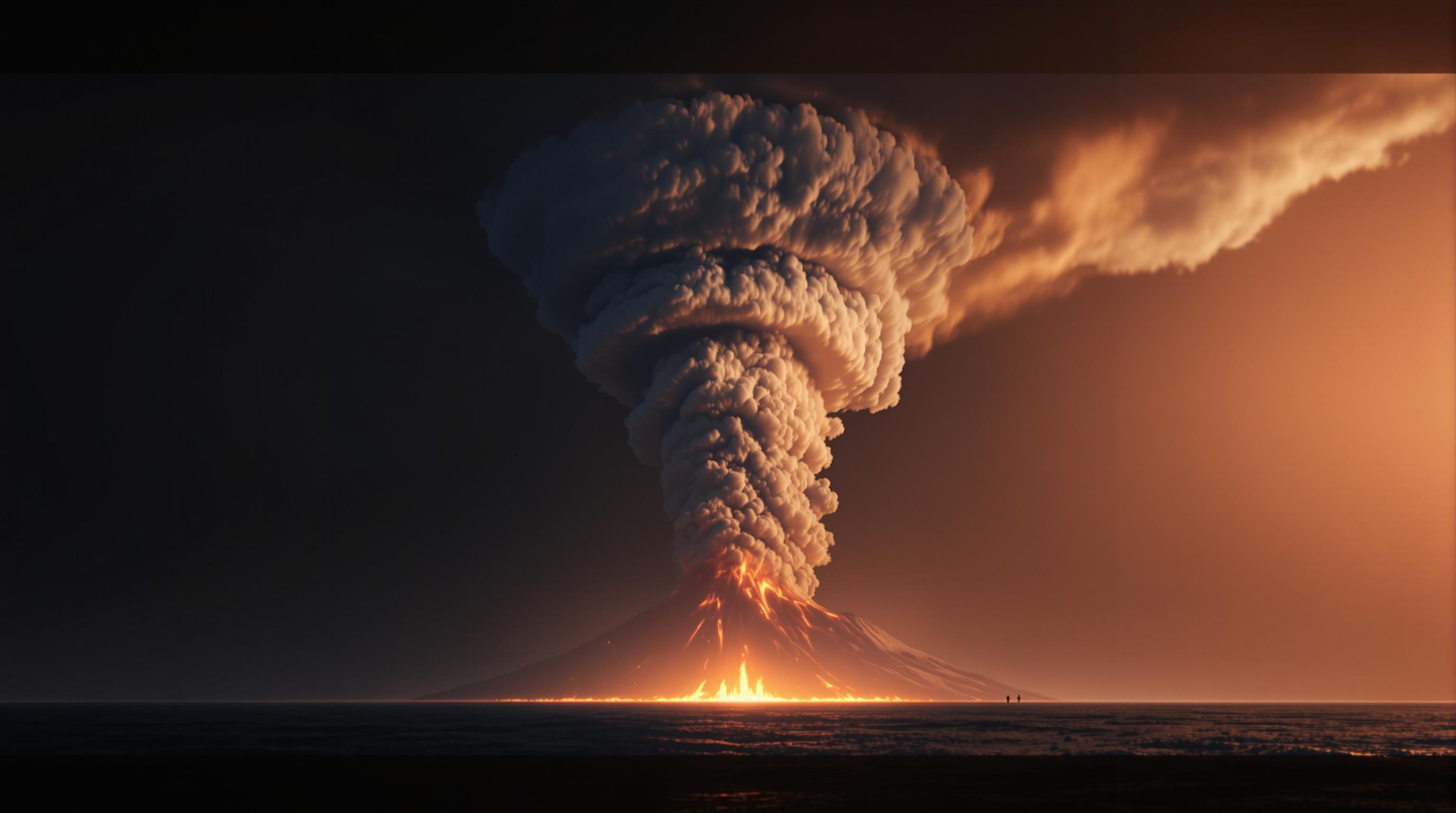
A record cloud of formaldehyde in the stratosphere
When the submarine volcano Hunga Tonga-Hunga Ha'apai erupted on 15 January 2022, it threw material to roughly 55 kilometers, among the highest eruption columns ever recorded. A day later, the TROPOMI instrument on the European Sentinel-5P satellite picked up an unusually strong signal of formaldehyde (HCHO), a gas that forms briefly when methane breaks down in the air, over New Caledonia. The enhancement lined up with separate satellite detections of sulfur dioxide, aerosol particles, and sulfate aerosol in the same plume, and researchers were able to distinguish two distinct clouds at slightly different altitudes, one around 30-32 kilometers and another around 27-29 kilometers.
The formaldehyde levels reached up to 12 parts per billion at around 30 kilometers altitude, with an uncertainty of about 10 percent, far above the levels normally seen at that height. Previous stratospheric measurements linked to biomass burning had shown formaldehyde below roughly a tenth of a part per billion at 20 kilometers, according to the study. Formaldehyde only survives a few hours in the stratosphere before sunlight breaks it apart, so an eruption-day burst of the gas should have almost entirely disappeared within a day or two. Instead, the elevated formaldehyde signal persisted, and researchers tracked the cloud for about ten days as it drifted as far as South America, which meant something inside the plume kept producing new formaldehyde well after the eruption itself was over.
Sources 1, 2, 3
Salt, sunlight, and volcanic ash: how methane may have been destroyed
The persistence of formaldehyde is the key evidence, because each methane molecule broken down in the atmosphere produces roughly one formaldehyde molecule as a short-lived byproduct. Since formaldehyde does not last long, its continued presence over ten days points to ongoing methane oxidation, not just a single burst tied to the eruption. The study estimates that methane oxidation proceeded at a rate of about 900 megagrams (a megagram is 1,000 kilograms) per day, and the researchers estimate that at least 330 gigagrams (a gigagram is a million kilograms) of volcanic methane had been injected into the stratosphere to sustain that.
The proposed mechanism traces back to earlier work by some of the same researchers on Saharan dust blowing over the Atlantic Ocean. There, dust particles combine with sea salt thrown up by ocean spray to form what the researchers call iron salt aerosols. Sunlight striking these particles releases chlorine atoms, and those chlorine atoms react with methane, helping break it apart. The new study proposes that a similar process occurred in the volcanic plume: seawater and volcanic ash thrown high into the stratosphere together, with sunlight then generating chlorine that attacked the methane released by the eruption. The researchers describe chlorine production from iron-chloride photochemistry in sulfate-coated volcanic ash as a plausible mechanism for this, calling for roughly 2 to 5 gigagrams of chlorine production per day that they say is not explained by previously known mechanisms.
This built on independent evidence that chlorine chemistry was active in the plume. A NASA satellite instrument had already detected enhanced chlorine monoxide and ozone loss inside the plume for about ten days, and separate modeling work found that a volcanic injection of 1.3 gigagrams of active chlorine could explain those observations. The new formaldehyde-based analysis is presented as also explaining low levels of another chemical, bromine monoxide, observed in the same plume.
Sources 1, 2, 3
Why researchers care about verifying methane removal
Methane is described in the study as the most important greenhouse gas after carbon dioxide, currently responsible for 0.5°C of warming, and it is about 80 times as potent as carbon dioxide over a 20-year period. Unlike carbon dioxide, methane breaks down naturally within about a decade, so cutting emissions now could measurably slow warming within roughly ten years. That fast turnover has led some researchers to describe methane cuts as an emergency brake on climate change, though the sources note that reducing carbon dioxide emissions remains necessary to stabilize temperatures over the long term. Because not all methane emissions can be eliminated through existing technology, and because natural methane emissions are rising as the world warms, researchers have also begun exploring ways to actively speed up methane's breakdown in the atmosphere, an approach called atmospheric methane removal.
A major obstacle to that field has been proving whether any removal method actually works. A National Academy of Sciences, Engineering, and Medicine report identified monitoring, reporting, and verification as a central challenge, concluding that adequate tools for measuring methane removal did not yet exist. The Tonga eruption offered a natural test case: because it produced a large, trackable plume where methane appears to have been broken down, it let researchers demonstrate that satellite measurements of formaldehyde could quantify that process, including over oceans, where satellites cannot directly measure methane itself due to low reflectivity of water. The study's authors describe their formaldehyde-based method as sensitive enough to also quantify the impact of any future engineered methane oxidation project.
Sources 1, 2, 3
What the findings do not settle
The eruption's sulfur dioxide output was, by volcanic standards, modest. Estimates of the amount released vary across independent studies: one satellite analysis in the new study cites hundreds of gigagrams, while another dedicated study of the eruption's SO2 emissions puts the total for the eruptive sequence at roughly 0.6 to 0.7 teragrams (equivalent to 600 to 700 gigagrams), well below the Mount Pinatubo eruption's roughly 20 teragrams in 1991. Researchers have proposed that seawater interacting with the erupting magma removed the majority of the sulfur that would otherwise have reached the stratosphere, though the study notes this remains an area of ongoing investigation.
The chlorine production rate the researchers calculate, 2 to 5 gigagrams per day, is explicitly flagged in the study as unexplained by known chemical mechanisms, with the iron-chloride pathway offered as a plausible but not confirmed explanation. The researchers also note that the discovery means dust, including volcanic dust, affects the global methane budget, the accounting of how much methane enters and leaves the atmosphere, and that this factor has not previously been included in such calculations. Whether an engineered version of this chemistry could be built safely and effectively for deliberate climate use is left as an open question in the sources, one they suggest their satellite-based verification method could help answer if such approaches are ever tested.
Sources 1, 2, 3, 4