Sound waves used to link and protect diamond quantum memories
Three separate research efforts suggest that mechanical vibrations, once seen as a threat to fragile quantum states, can instead be used to connect and shield them.
What happened
Researchers working with diamond-based quantum bits, or qubits, have reported progress on two long-standing problems at once: how to connect many qubits together, and how to keep each one from losing its quantum information too quickly. A team from TU Wien and Harvard University used simulation calculations to show that tiny mechanical vibrations could carry quantum information between multiple defects embedded in a diamond rod, a step toward linking many qubits together. Separately, researchers at Harvard's John A. Paulson School of Engineering and Applied Sciences demonstrated a technique that uses continuous mechanical vibrations to protect a diamond spin qubit's quantum state, extending its coherence time by roughly a factor of three. A third study, published in Nature Communications, used a mechanical device to physically strain a diamond chip and showed this could stretch a spin qubit's coherence time from about 40 nanoseconds to roughly a quarter of a microsecond.
All three efforts center on the same kind of quantum system: a defect in diamond's crystal structure, created by placing a silicon atom into the lattice. These defects, called silicon-vacancy centers, can store quantum information in the state of an electron and can also emit particles of light, making them candidates for quantum networks that would connect distant qubits. The obstacle, as the TU Wien team put it, is that it is very difficult to connect enough of these systems to carry out complex computing operations. The new results, described in three different papers, each tackle a different piece of that obstacle using mechanical vibrations.
Sources 1, 2, 3
How defects and vibrations combine to hold and move information
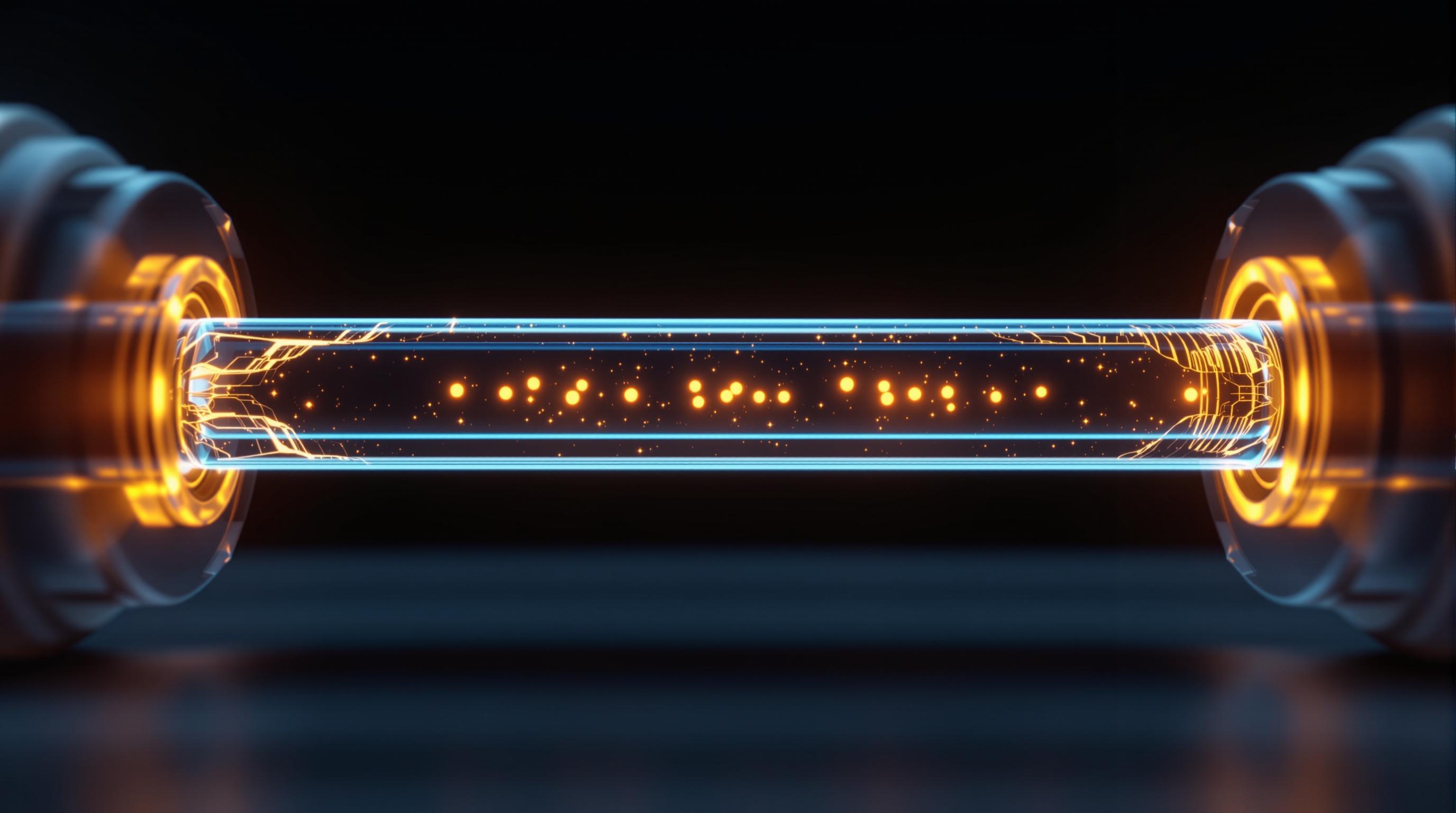
A silicon-vacancy center works like a switch built into the diamond's crystal lattice: it can be flipped between a higher-energy state and a lower-energy state using microwaves, and the state it is in stores a piece of quantum information. In the TU Wien and Harvard proposal, several of these defects would be built one by one into a diamond rod only a few micrometers long, arranged like beads on a string. That rod can be made to vibrate, much like a tuning fork, except the vibrations are so small they can only be described using quantum theory. Sound waves at this scale are made of phonons, the smallest possible units of mechanical vibration, in the same way that light is made of photons.
According to the researchers' calculations, switching the silicon atoms on and off with microwaves causes them to emit or absorb these phonons, and this creates a quantum link between separate defects that can be used to transfer information between them. This was not an obvious result: phonons are usually expected to be absorbed by their surroundings or to lose their quantum properties on contact with the environment, which is why the TU Wien researchers describe them as normally 'the enemy of quantum information'. Their calculations indicate that, when controlled carefully with microwaves, phonons can instead be put to use rather than lost. The Harvard SEAS work builds on the same physical picture, describing phonons as carrying two jobs in a network built this way: transmitting quantum information between qubits and, as described in the next section, protecting it while stored.
Sources 1, 3
Making the qubits harder to disturb
Storing information is only useful if it survives long enough to be read out, and diamond spin qubits are normally disturbed quickly by their environment. In the Nature Communications work, researchers built a diamond cantilever, a beam fixed at one end like a tiny diving board, with electrodes above and below it. Applying a voltage bends the cantilever and stretches the diamond lattice around the embedded silicon-vacancy defect, and this stretching, or strain, changes the energy gap between the defect's internal states. Pushing that gap far above the thermal energy available in the surrounding crystal starves the defect of the resonant phonons that would otherwise disturb it, and the researchers found this suppression improved the qubit's coherence time from about 40 nanoseconds to 0.25 microseconds.
The Harvard SEAS team took a different route to the same goal. Instead of the microwave pulses conventionally used to decouple a qubit from its environment, which do not work well inside the phononic cavities used to trap vibrations, they applied a continuous mechanical driving field made of phonons directly to the qubit. This shifts the qubit into what the researchers call a 'dressed' state, one that is less sensitive to slow-changing noise in its surroundings because it is, in their words, wearing a continuous acoustic field. Because the protection comes from a mechanical field rather than microwaves, it works inside the same phononic cavity structures that would eventually be used to link stationary qubits in a network, and the team reports this extended the silicon-vacancy spin's coherence time by roughly a factor of three.
Sources 2, 3
What is still unproven
The TU Wien and Harvard proposal for linking multiple qubits through a vibrating diamond rod is, at this stage, based on simulation calculations rather than a built device, so it remains a theoretical demonstration that the approach could work rather than a working multi-qubit network. The strain-tuning experiment reported coherence times still measured in fractions of a microsecond, and its measurements of phonon absorption and emission rates were confined to a limited range of orbital splittings where the pump-probe technique used could be applied. The Harvard SEAS coherence protection technique also produced a coherence time extended by only about a factor of three, and the researchers describe their result as establishing that continuous mechanical noise suppression can lengthen coherence in real devices, rather than as a solved problem.
Sources 1, 2, 3