New LSD-based molecule promotes brain rewiring without causing hallucinations
Swapping two atoms in LSD's structure produced a compound that repairs neural connections in mice while avoiding effects tied to psychosis, opening a route to treating schizophrenia with a psychedelic-derived drug.
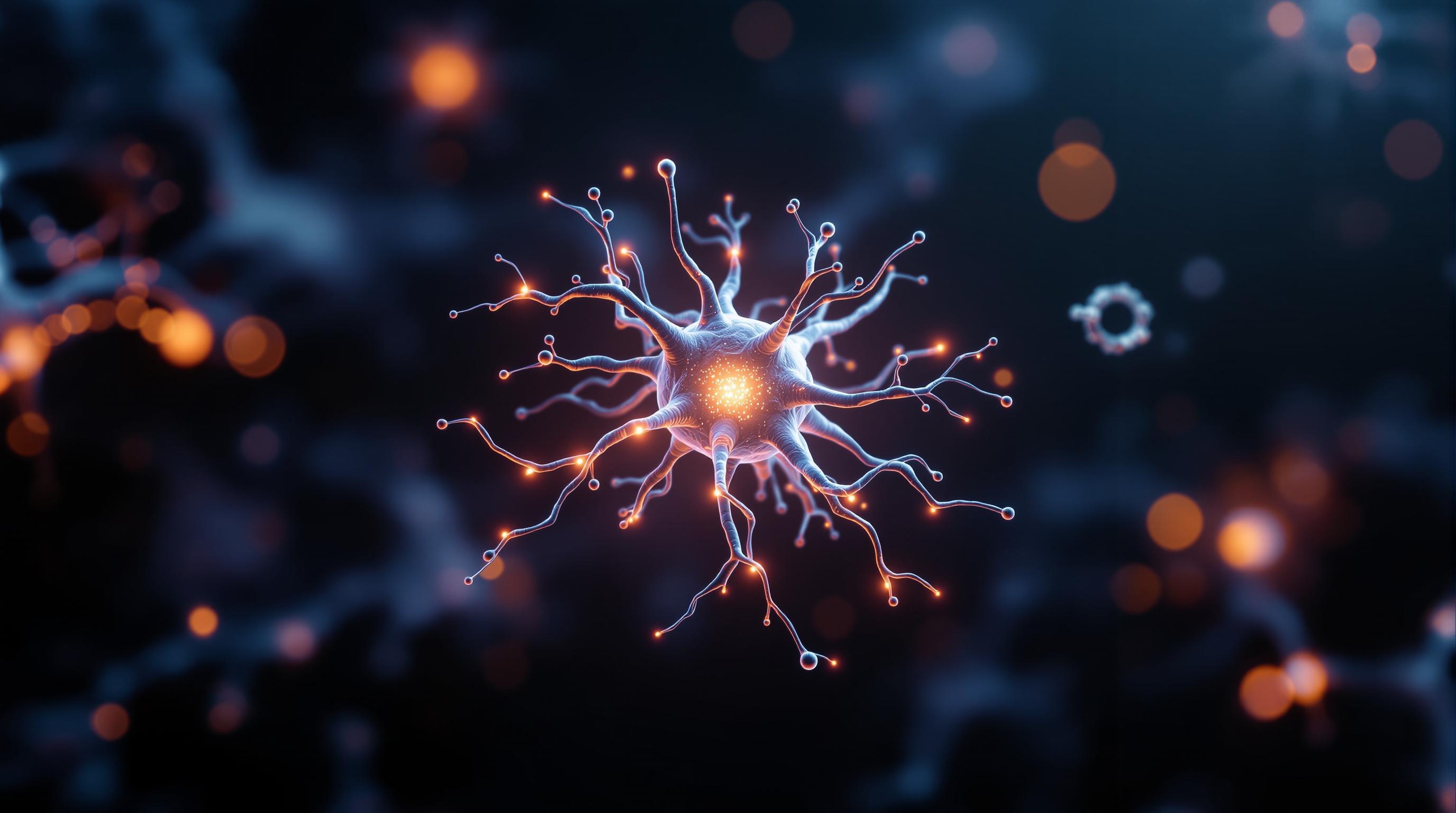
A modified LSD molecule, tested in mice
Researchers at UC Davis and UC San Diego have created a new drug closely related to LSD, called JRT, that appears to retain LSD's ability to repair brain connections while sharply reducing its hallucinogenic potential. The work, published in the Proceedings of the National Academy of Sciences, was led by chemist David E. Olson at UC Davis and biologist Uri Manor at UC San Diego. The study was funded by the National Institutes of Health, along with several other foundations and awards.
The researchers built JRT by flipping the position of two atoms in LSD's molecular structure. Olson described the change as "a tire rotation": JRT and LSD share the exact same molecular weight and overall shape, but the small structural swap gave JRT distinct pharmacological properties. It took nearly five years and a 12-step synthesis process for the team to produce the compound, which is named after Jeremy R. Tuck, a former graduate student in Olson's lab who first synthesized it.
LSD itself is not given to people with schizophrenia because of safety concerns. A separate review of LSD's pharmacology notes that the drug can produce delusions, visual hallucinations, and impaired thinking, and that at higher doses it has historically been used to model temporary psychotic states in research settings. Olson said that no one really wants to give a hallucinogenic molecule like LSD to a patient with schizophrenia, which is part of why his team looked for a way to keep LSD's beneficial effects while removing the hallucinogenic ones.
Sources 1, 3, 4
How JRT changes neurons
Earlier work from Olson's lab, published in Cell Reports, had already shown that a range of psychedelic drugs, including LSD and MDMA, increase the number of branches on neurons, the density of small protrusions on those branches called dendritic spines, and the number of connections between neurons known as synapses. Dendritic spines and synapses are key structures for how neurons communicate, and their loss is associated with several psychiatric and neurodegenerative conditions. That study found rats given a single dose of the psychedelic compound DMT showed increased dendritic spines that persisted for 24 hours, even though most of the drug itself was eliminated from the body within an hour. Olson's team coined the term "psychoplastogen" to describe this class of plasticity-promoting compounds.
In the new study, the Manor lab used high-resolution 3D electron microscopy to examine brain tissue from the prefrontal cortex of mice treated with JRT, comparing it to tissue from untreated mice. The scans showed a 46% increase in dendritic spine density and an 18% increase in synapse density in JRT-treated mice. Manor said this kind of imaging can help researchers distinguish between compounds that bind to the same receptors in similar ways but produce very different effects in the brain over time.
JRT is highly selective for binding to a specific serotonin receptor called 5-HT2A, whose activation is described in the study as key to promoting the growth of cortical neurons. Despite this potent binding, JRT did not produce hallucinogenic-like behaviors that are typically seen when mice are given LSD, and it did not increase gene expression patterns associated with schizophrenia the way LSD does.
Sources 1, 2
Effects relevant to schizophrenia and depression
Beyond its effects on neural structure, JRT improved measures in mice that are relevant to the negative and cognitive symptoms of schizophrenia, without worsening behaviors or gene expression linked to psychosis. It also promoted cognitive flexibility, helping mice overcome deficits in a task called reversal learning that are associated with schizophrenia. Olson noted that most current schizophrenia treatments have limited effects on cognitive function and on anhedonia, the inability to feel pleasure.
One existing drug, clozapine, is an exception in treating these symptoms, but it is reserved as a last resort because of side effects that Olson described as "nasty," including weight gain, metabolic problems, sedation, and a condition involving dangerously low white blood cell counts. JRT did not produce these side effects in the study, which Olson attributed to its more selective pharmacology, meaning it acts more narrowly on specific receptors than clozapine does.
The study also reported that JRT produced strong antidepressant-like effects in mice, roughly 100 times more potent than ketamine, which is currently used as a fast-acting antidepressant. This finding echoes earlier work from Olson's group showing that psychedelics such as DMT can mimic ketamine's effects on neurons and behavior, including helping rats overcome a learned fear response in a test considered a model of post-traumatic stress disorder.
Sources 1, 2
What is still unknown
The findings described here come from mouse studies, and the study's authors themselves note they are now testing JRT against other disease models and refining its synthesis, alongside creating new analogues that might perform even better. Whether JRT's effects in mice will translate to similar safety and efficacy in humans has not yet been established by these sources. Olson is also chief innovation officer at Delix Therapeutics, a company aiming to bring this class of neuroplasticity-promoting drugs to market.
A broader review of LSD's pharmacology notes that the drug's mechanisms are still not completely understood, and that its complex effects on receptors beyond the serotonin system, including dopamine receptors, have been studied for decades without full resolution. This underlying complexity is part of why a small structural change, like the one used to create JRT, can shift a molecule's effects so substantially while leaving its basic shape and weight unchanged.
Sources 1, 3, 5