Lead in ancient ink helps X-rays reveal text in unopened Herculaneum scrolls
A lab-made copy of the burned scrolls shows that hunting for lead first could tell researchers which of the hundreds of unread papyri are worth scanning in detail.
A library buried by Vesuvius, still unread
When Mount Vesuvius erupted in 79 CE, volcanic gas and ash buried the Roman town of Herculaneum and carbonized more than a thousand papyrus scrolls stored there. Those scrolls, now brittle and blackened, form what is described as the only known complete library to survive from antiquity. A few were physically unrolled after their discovery in 1752, but many crumbled into ash, and hundreds remain sealed in Italy's National Library of Naples.
Researchers have spent years trying to read the scrolls without opening them, using X-ray scanning combined with computer algorithms to reconstruct the text virtually. The Vesuvius Challenge, a competition offering cash prizes for this work, has produced results: the first readable text was rewarded with a $700,000 prize, an X-ray image of the inside of one Bodleian Libraries scroll followed, and a full scroll called PHerc. 1667 was read this year, revealing a philosophical treatise on ethics and human moral progress.
The obstacle has been that both the ink and the papyrus are made of carbon, so standard scans struggle to tell them apart. A new study led by Douglas Seiler, a research volunteer at the University of California, Berkeley, working with the National Institute of Standards and Technology (NIST), reports a way around that problem using lead. The work is published in PLOS One.
Sources 1, 2, 4, 5
Why lead stands out where carbon does not
The core problem, as Seiler put it, is that a Herculaneum scroll is close to a brick of charcoal: ink and paper alike are carbon, so X-rays pass through both at nearly the same rate. Lead absorbs X-rays far more strongly than papyrus does, so any scroll whose ink contains lead should show its letters clearly against the surrounding material in an X-ray image. That contrast is already known to help human readers: earlier synchrotron mapping of two real Herculaneum fragments, described by a team including Vito Mocella of Italy's National Research Council, had shown lead concentrated exactly where the letters were, with concentrations estimated at 84 micrograms per square centimeter in one fragment and 16 in the other.
Not every ancient ink contains lead, since scribes did not follow one recipe. Earlier work by Brent Seales, a computer scientist at the University of Kentucky who first identified metallic ink in a Herculaneum scroll in 2009, and a 2016 study that found lead in two fragmented scrolls both pointed to intentional use of the metal rather than accidental contamination. Seales has said the variation seen across scrolls, and the generally low concentrations, suggest the metal was an accidental addition rather than a standard ingredient.
Seiler's team built the case that screening for lead first could guide which scrolls get the more intensive scanning. They propose testing scrolls with a handheld X-ray fluorescence, or XRF, instrument, which identifies elements by shining X-rays onto a surface and reading the energies of the X-rays that come back out. If a scroll returns a lead signal, it becomes a stronger candidate for the detailed 3D imaging needed to extract its text.
Sources 1, 3, 4, 5
Building and burning replica scrolls to test the idea
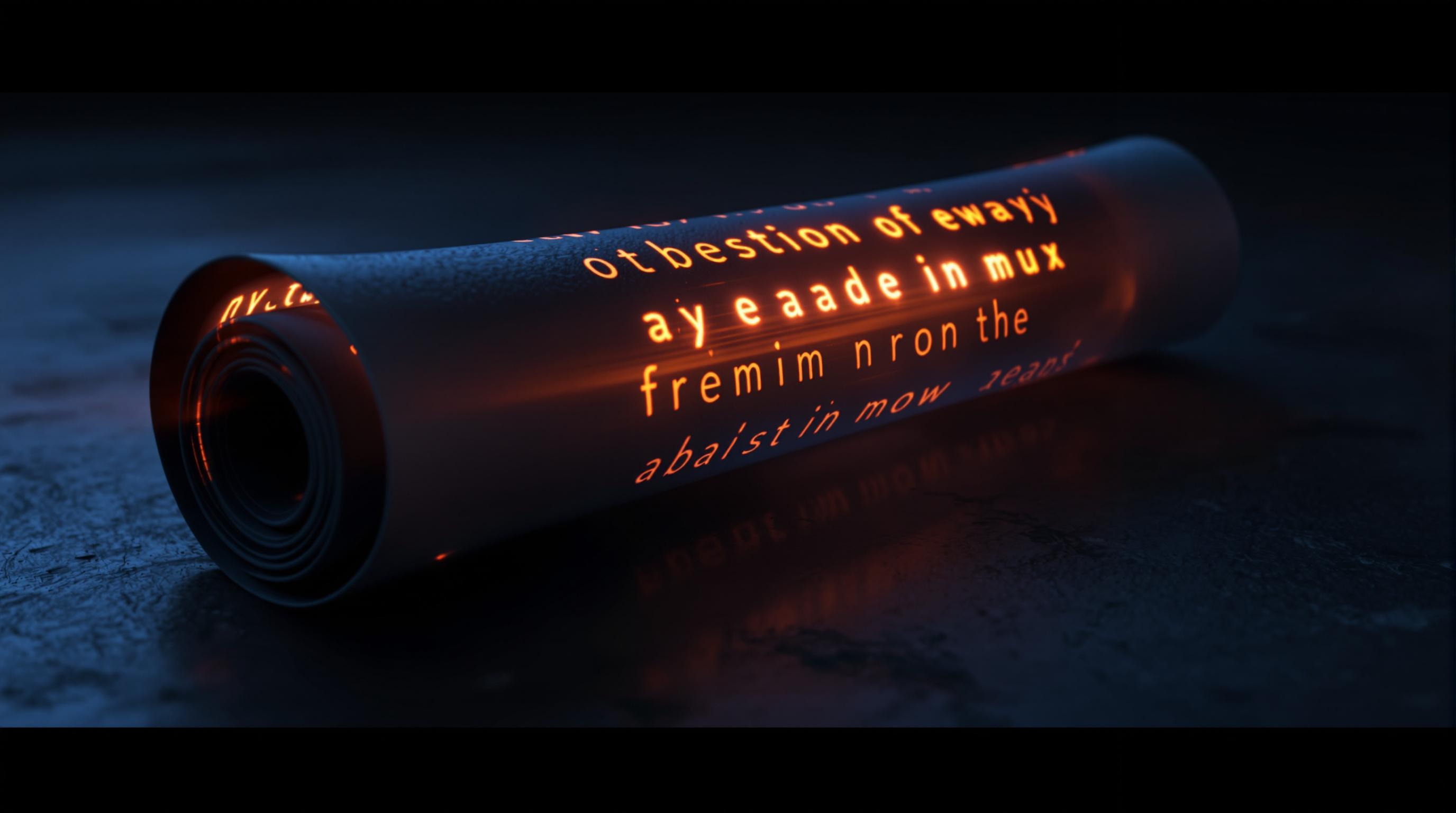
To test whether the lead signal would survive the damage of carbonization, the team built its own scrolls from scratch rather than working with the real, fragile originals. They used modern Egyptian papyrus and reed pens, and carbon-black ink made in the style used at the time, spiking it with varying amounts of lead. They inscribed passages that included material from the Bible and scripts from old films and television shows, rolled the papyrus up, and carbonized it in a low-oxygen, high-temperature kiln to mimic the conditions of the eruption.
The handheld XRF instrument picked up a lead signal in every sample tested, down to a surface concentration of 25 micrograms per square centimeter, which is lower than the lowest concentration measured in the real ancient fragments. Physicist Jake LaManna of NIST then created 3D X-ray scans of the charred models, collecting images from many angles to build up a three-dimensional picture of the writing sealed inside. Seiler described the effect as the letters lighting up clearly once the scans ran.
Turning those scans into readable text required unrolling the scroll data digitally rather than physically. NIST researcher Michael Cyrus Daugherty adapted a piece of software he had originally written to unroll CT scans of the coiled layers inside lithium-ion batteries, repurposing it to digitally unwrap the model scrolls instead. The team reports that the reconstructed images picked up the lead-marked words more clearly than they expected, at every lead concentration level they tried.
Sources 1, 2, 4, 5
What the method can and cannot do
The authors suggest their approach could help identify which of the more than 600 unopened Herculaneum scrolls are the best candidates for the effort-intensive process of virtual unrolling. Because a handheld XRF scan takes minutes, Seiler said facilities could quickly find out whether a given scroll contains lead before committing to full imaging. He also noted that a lead signal is very strong, in contrast to the faint difference between carbon ink and carbon paper that has hampered earlier attempts.
The method has real limits. It does not help with scrolls written in ink that contains no lead at all, since there is nothing there for the X-rays to pick out. Mocella, who was not involved in the study, points out that his own XRF work on Herculaneum fragments has found other metals in some ancient inks besides lead, and suggests future scans should look for those too.
Mocella also cautions that the lab-made scrolls do not capture the full extent of the damage suffered by the real ones. The ash and pressure from the eruption shattered and distorted the original scrolls far more than the kiln firing did to the replicas. He describes the study as a first step and a good workflow, rather than a finished solution. Seales, who was not involved either, similarly stressed that scrolls without metal in the ink are not unreadable, only harder, and that the Vesuvius Challenge has shown that AI analysis can still extract evidence of ink even from the most stubborn scrolls.
Sources 1, 4, 5