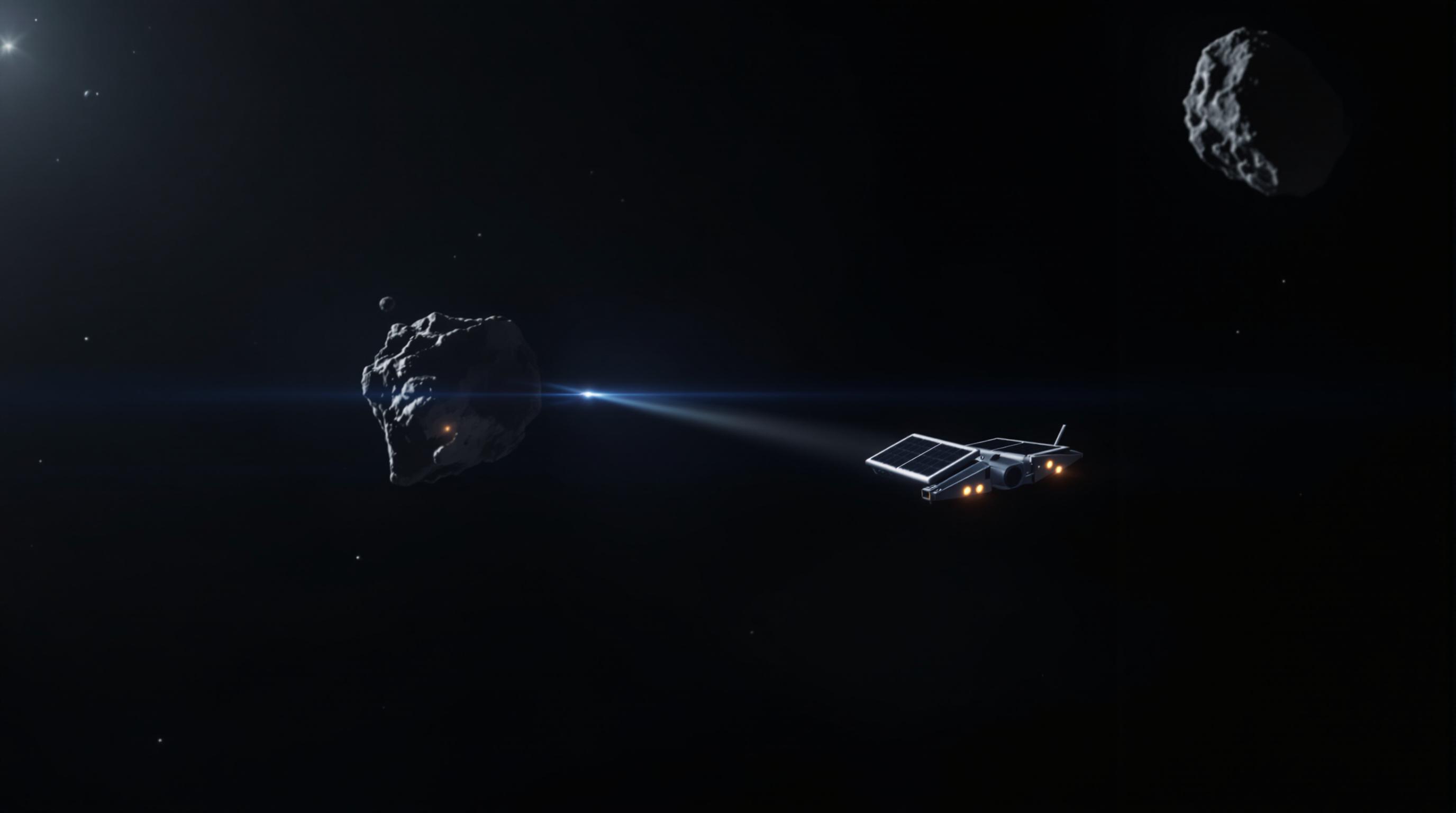
Hayabusa2 fires laser at asteroid Torifune during high-speed flyby
The test shows a spacecraft can pin down an asteroid's exact distance while flying past it at 18,000 kilometres per hour, a technique that could sharpen predictions of which asteroids might one day threaten Earth.
A flyby and a first
On 5 July 2026 at around 18:30 Japan Standard Time, JAXA's Hayabusa2 spacecraft flew past the asteroid Torifune, the first target of its Extended Mission after the probe's original journey to asteroid Ryugu and its sample return to Earth in December 2020. Ground controllers confirmed the spacecraft was operating normally shortly after the encounter. JAXA has released images of Torifune taken by two onboard cameras, one capturing visible light and one measuring heat, along with a note that the flyby time is still a preliminary estimate.
During the same flyby, the mission achieved what a report from Universe Today describes as the first successful laser ranging experiment ever performed on an asteroid. The spacecraft's laser instrument fired twice in the final seconds before closest approach, bouncing light off Torifune's surface to measure the distance between the two. JAXA says only part of the data collected by its instruments has reached Earth so far, with the rest to be transmitted during later operations.
Sources 1, 3
How the laser measurement worked
The instrument responsible, called LIDAR (Light Detection and Ranging), works by firing a pulse of laser light at a surface and timing how long it takes the reflected light to return. That travel time, combined with the known speed of light, gives a precise distance. According to Universe Today, the laser fired at 06:29 p.m. Japan time, at the 56.5 and 57.5 second marks, from distances of about 20 kilometres and then 15 kilometres from Torifune, three to four seconds before the spacecraft passed the asteroid.
Hitting a small target at all was difficult, because Hayabusa2 was moving at 5.3 kilometres per second, over 18,000 kilometres per hour, while the laser had to be aimed precisely and the instrument's other settings tuned to avoid picking up stray background light instead of the real reflection. According to Universe Today, the narrow laser beam struck only a small patch of Torifune's surface each time, about 30 metres and 23 metres across for the two pulses. The mission team says it is now working to pin down exactly where on the asteroid's surface the laser actually touched down.
JAXA notes that observations were not limited to the laser instrument. Starting about an hour before closest approach, the spacecraft also used a near-infrared spectrometer, which looks for signs of water or hydroxyl groups in surface material, and a thermal infrared camera, which measures surface temperature and roughness. All of these instruments kept observing right up until the moment Hayabusa2 passed Torifune, but none could continue once the spacecraft had moved beyond it.
Sources 1, 2, 3
Why measuring distance this way matters
The laser altimeter was originally built for a more basic job: helping the spacecraft navigate by giving it a running measurement of its own distance from the asteroid, according to the National Astronomical Observatory of Japan, which helped develop the instrument. But the same measurements can serve scientific purposes as well. Because a spacecraft falling freely toward an asteroid speeds up according to that asteroid's gravity, tracking the fall precisely can reveal the asteroid's mass; combined with a shape model built from laser and camera data, that mass estimate could in turn be used to estimate the asteroid's density and how porous, or full of empty space, its interior is.
Universe Today notes that laser ranging also adds a sense of scale to spacecraft images, which otherwise offer no built-in reference for how big or how far away an object is. Multiple ranging measurements taken over time, combined with tracking data on the spacecraft's own position, can be used to work out an asteroid's trajectory more accurately. The same report states that this has implications for planetary defense, since more accurate orbital predictions help scientists judge which asteroids might pose a future collision risk. The successful test also demonstrates that this kind of measurement can be gathered even while a spacecraft is moving at high velocity during a brief flyby, rather than requiring an extended stay near the target.
Sources 2, 3
What is still unresolved
Much of the data from this flyby has not yet made it back to Earth. JAXA states that only part of the information gathered by Hayabusa2's scientific instruments has been transmitted so far, with the remainder to follow in future communication sessions. The exact timing of the flyby and the laser pulses is also still described as a preliminary estimate rather than a final figure.
The mission team is still working out precisely where each laser pulse landed on Torifune's surface, according to Universe Today, a detail that will refine what scientists can conclude about the asteroid's shape and composition. The broader scientific goals for the LIDAR instrument, including estimates of the asteroid's density, porosity, surface reflectivity, and the possible presence of dust particles hovering just above its surface, were outlined by the National Astronomical Observatory of Japan as expected results rather than confirmed findings, and depend on further analysis of the data collected.
Sources 1, 2, 3