Anak Krakatau eruption sends ash to 15,000 metres, grounds thousands of flights
A more than 24-hour eruption forced Indonesia to close eight airports and pushed volcanic gas high enough into the atmosphere that satellites tracked it drifting across two islands.
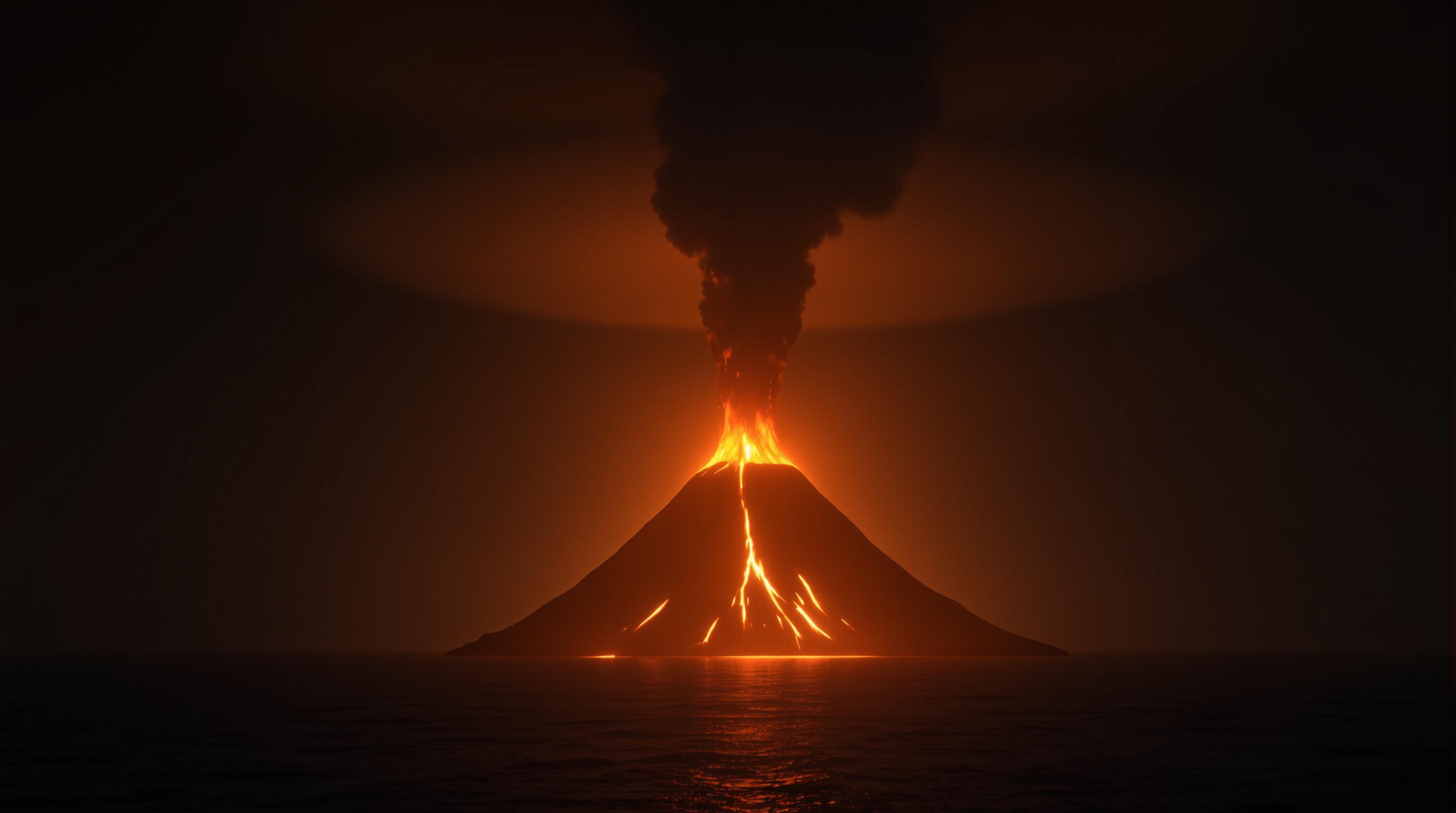
A day-long eruption grounds air travel across western Indonesia
Anak Krakatau, a small volcanic island sitting in the Sunda Strait between Java and Sumatra, began erupting late on Friday, according to the Associated Press. Indonesia's Geological Agency recorded two more eruptions early Sunday, one lasting 30 seconds and another about three hours later lasting 16 seconds, with lava fountains visible on closed-circuit camera footage. NASA Science reported that the continuous explosive phase of the eruption lasted more than 24 hours before the volcano settled into a more typical pattern of intermittent ash bursts, known as Strombolian eruptions, on 6 September.
Indonesia's meteorological agency, BMKG, tracked two distinct ash clouds. One reached about 6,000 metres (20,000 feet) and drifted over Jakarta and West Java, while a second, higher plume reached about 15,000 metres (50,000 feet) and spread over Sumatra's Banten, Lampung, and Bengkulu provinces, according to both the BBC and Al Jazeera. Eight airports on Java and Sumatra closed because of the ash, including Jakarta's Soekarno-Hatta International Airport, the country's main hub. Sources give different counts for how many flights and passengers were affected: the AP and BBC reported 1,558 canceled or delayed flights and 170,000 stranded passengers as of Sunday evening, Al Jazeera's Monday report put the cumulative total at more than 270,000 passengers stranded since 5 September, and NASA Science's list of cited news reports includes a later BBC figure of 340,000 stranded and nearly 3,000 disrupted flights by 8 September. Airports had resumed operations by 8 September, per NASA Science, though the volcano remained at the second-highest alert level on Indonesia's warning scale, a status it has held since early July.
Sources 1, 3, 4, 5
Satellites track two separate ash and gas clouds moving in different directions
Satellite instruments captured the eruption from multiple angles. The Japanese Himawari-9 satellite recorded the eruption beginning around 1620 UTC on 4 September using an imaging technique called an Ash RGB, which colors ash clouds in shades of red to magenta and separates them from a sulfur dioxide gas cloud shown in yellow-green, according to the CIMSS Satellite Blog. The ash cloud stayed closer to the volcano in the middle atmosphere, while the sulfur dioxide cloud moved quickly to the west-southwest at a higher altitude. A NASA-USGS Landsat 8 image from 5 September showed a white plume of volcanic gas sitting above a brown ash cloud, and a wider view from the Suomi NPP satellite's VIIRS instrument showed the material spreading over a large area, per NASA Science.
A height-tracking product from the NOAA/CIMSS Volcanic Cloud Monitoring site estimated the ash reached maximum altitudes of 18 to 20 kilometers. Weather balloon data from Jakarta's airport showed light, variable winds in the middle atmosphere but stronger easterly winds higher up, in a layer roughly 9.7 to 12.5 kilometers above ground — a pattern consistent with the ash and gas clouds splitting and traveling in different directions, as CIMSS reported. Volcanic ash was recorded in official airport weather observations at Jakarta beginning at 1900 UTC on 5 September, with surface visibility reduced to 4-7 miles, and more than 200 flights were suspended from Jakarta's airport on 6 September as residual ash lingered at lower altitudes, according to CIMSS.
Sources 1, 2
Ashfall irritates eyes and lungs, prompts school closures, but no tsunami warning
Ashfall reached populated areas, particularly east of the volcano in Jakarta and other parts of West Java, according to the Indonesia Humanitarian Coordination Platform, as cited by NASA Science. Volcanic ash can irritate the respiratory tract, eyes, and skin, and the platform noted that this hazard differs from smoke produced by separate peatland fires burning elsewhere in Indonesia, in terms of the particles involved, how they spread, and how people should protect themselves. The BBC reported that Indonesia's health minister urged residents in affected areas to stay indoors and wear face masks, and quoted a Jakarta resident, Aldi Candra Prayogi, describing the sensation as feeling like "small grains of sand" had gotten into his eyes, requiring eye drops for relief. He also said the ash was thick enough that he had to sweep his yard every five minutes.
The Indonesian government authorized schools in ash-affected areas to move temporarily to online learning, a measure intended to reduce children's exposure, according to the AP; Al Jazeera reported that schools across Jakarta specifically moved classes online, without saying for how long. Indonesia's disaster mitigation agency, BNPB, said there was no imminent tsunami risk from the eruption and announced plans to seed clouds to encourage rain that could wash ash out of the air, according to Al Jazeera. Ships passing through the Sunda Strait were asked to increase vigilance, and vessels were barred from a three-kilometer exclusion zone around the volcano, per Al Jazeera. The AP reported that the nearest settlement is more than 16 kilometers from the volcano, and authorities warned people to stay at least 3 kilometers from the active crater, though no evacuation order was issued and no casualties were reported.
Sources 1, 3, 4, 5
A volcano with a history of collapse, and no way yet to predict what comes next
Anak Krakatau, whose name means "child of Krakatau," emerged from the sea in the caldera left by the catastrophic 1883 eruption of Krakatoa, one of the deadliest volcanic events on record, according to Al Jazeera. In December 2018, the volcano partially collapsed, and researchers believe the collapse triggered an underwater landslide that displaced a large volume of water, causing a tsunami that killed more than 400 people along the coasts of Java and Sumatra, per the AP and BBC. Scientists found the island was reduced to about a quarter of its original size after that collapse, the AP reported, and some of the rock chunks that slid off during the collapse were about 70 to 90 meters high, according to the BBC.
Lana Saria, head of Indonesia's Geological Agency, said activity at Anak Krakatau has intensified since July, with the early September eruption the strongest of that period, according to the AP. She said the repeated eruptions point to a continued supply of magma and volcanic gases beneath the volcano, but cautioned that officials cannot predict whether a larger eruption will occur, and that they are evaluating the volcano based on all available monitoring data rather than simply counting eruptions or measuring ash column height. The main hazards she identified are volcanic ash, high concentrations of gas, and the ejection of hot rocks near the crater. As of NASA Science's report, the volcano remained at the second-highest alert level on Indonesia's scale, a status in place since early July, and continued to rumble even after the main explosive phase subsided.
Sources 1, 3, 5