AI search by protein shape uncovers a hidden human protein that builds cell-to-cell bridges
The discovery points to an overlooked layer of biology that may show how cells cooperate, compete, and possibly fuel cancer growth.
A search by shape turns up an unknown protein
Researchers at Sylvester Comprehensive Cancer Center, part of the University of Miami Miller School of Medicine, used artificial intelligence to compare the predicted three-dimensional shapes of more than 214 million proteins. Rather than searching by genetic sequence, the traditional way scientists have studied proteins for decades, they searched by physical form. That approach turned up previously unrecognized members of the G protein-coupled receptor family, or GPCR, a group of proteins that helps cells sense and respond to signals from outside themselves.
One protein stood out: TM184C. It resembled a GPCR in shape, but the research team found it behaved differently from known members of that family. The findings were published in Nature.
"For decades, we have largely explored protein biology using sequence as our guide," said Daniel Isom, the study's senior author and a researcher at Sylvester. "We wanted to know what biology we might be missing if we searched by three-dimensional structure instead. What we found suggests there is another layer of biology that has been hiding in plain sight."
Sources 1, 2
Vesicles, bridges and a recycling system
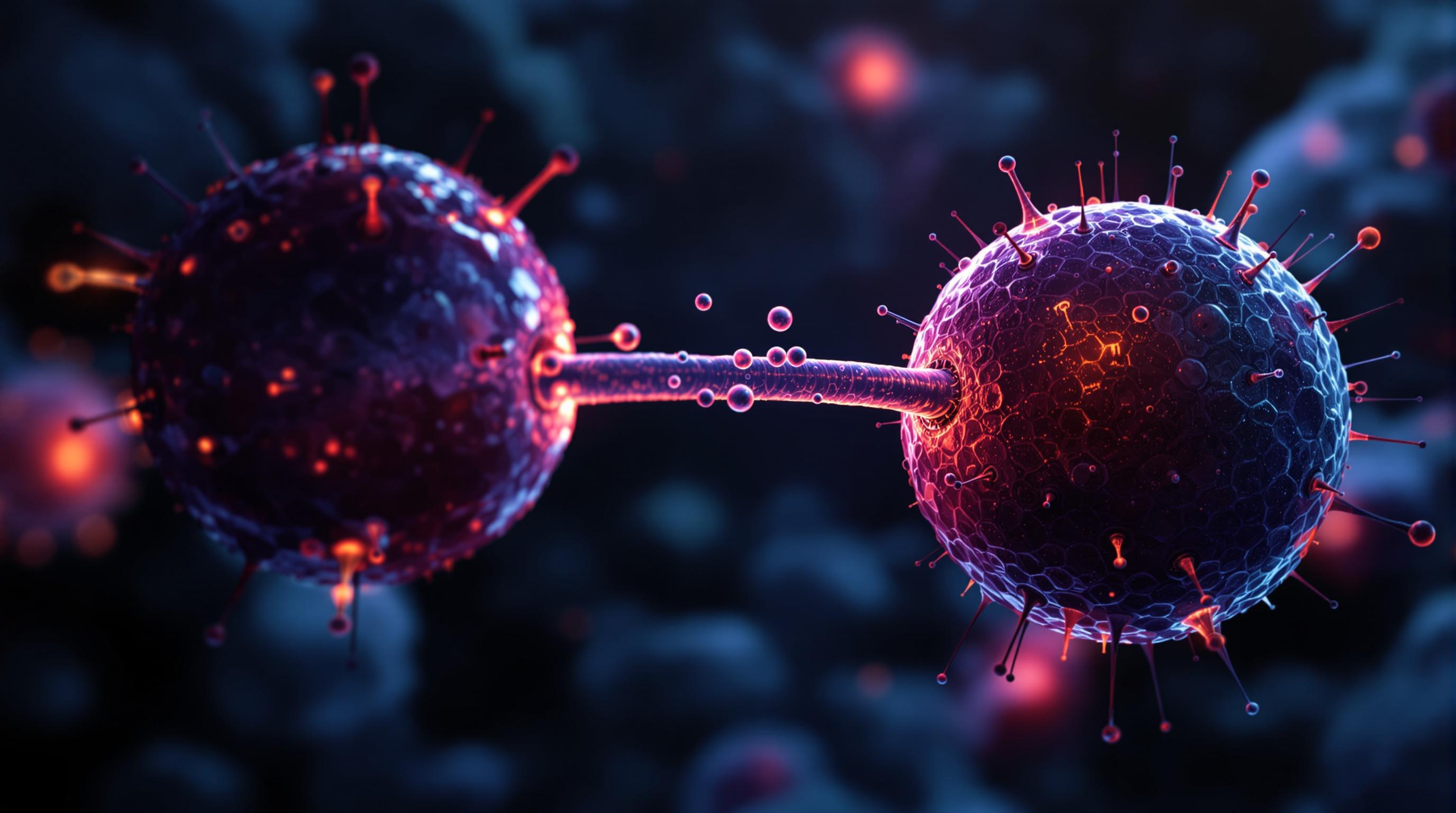
Most of TM184C was found inside the cell, embedded in the membranes of small transport packages called vesicles. These vesicles moved along microtubules, structures that act as internal tracks inside the cell, and gathered in thin projections that link one cell to its neighbor. Through those projections, cells exchanged metabolites, vesicles, and organelles, including mitochondria, the structures that generate a cell's energy. When researchers disrupted TM184C, cells formed fewer of these connections and showed altered shape and vesicle organization, which suggested the protein helps build and manage the connections.
"When we saw TM184C-positive vesicles moving through connections between cells, we realized these structures could be routes for substantial material exchange," said Jenniffer Arcuri, a senior scientist at Sylvester and the study's lead author. That observation changed how the team thought about the protein's role, prompting them to consider how cells might use these connections to cooperate or compete for resources.
TM184C also appeared to help regulate autophagy, the process a cell uses to break down and recycle its own damaged or unneeded parts. When researchers reduced TM184C, markers of autophagy increased, suggesting the protein normally helps tune how much recycling occurs. The team also studied a similar protein in yeast, called Hfl1. Removing Hfl1 caused problems in yeast cells, but adding the human TM184C protein fixed those problems, showing that this function has been preserved across roughly a billion years of evolution separating yeast from humans.
Sources 1, 2
Cooperation, competition and cancer
The discovery raises a basic question about who benefits when cells share resources through these bridges. In healthy tissue, the exchange may help cells survive stress by moving fuel or damaged components to where they are needed. But if the exchange is unequal, researchers noted, one cell could gain at another's expense.
"I think cells coordinate until they have to compete," said Shraddha Chandthakuri, a graduate student in the Isom lab. "When the cells are stressed, they may coordinate to redistribute the proteins, organelles, and metabolites to support the survival of the population as a whole."
In cancer, tumor cells often grow in conditions with limited oxygen and nutrients. Cell-to-cell bridges could give some tumor cells another way to survive, by sharing resources or drawing support from neighboring cells. Graduate student Bruno Colon said he is studying how these connections occur in normal cells and in aggressive cancers such as glioblastoma, work he said could reveal how tumors communicate and expose vulnerabilities not previously recognized.
Sources 1, 2
A wider push to read biology by shape, with caution attached
The TM184C finding sits within a broader effort to use AI-predicted protein structures to find biological function that sequence alone misses. Separately, researchers at Brookhaven National Laboratory built a model called ESMBind, based on two AI programs originally developed by Meta, to predict how proteins bind to metals such as zinc and iron; that work is aimed partly at engineering biofuel crops and protecting them from disease. A review published in Frontiers in Molecular Biosciences notes that models such as AlphaFold3 and RoseTTAFold have brought near-experimental accuracy to structure prediction, while single-sequence approaches such as ESMFold offer substantial gains in speed and scalability, and the review cautions that structure prediction, docking, and functional annotation are distinct tasks with different sources of uncertainty. A related review on PubMed Central points out that fewer than 0.1% of proteins have experimentally validated functional annotations, underscoring how much of the protein universe remains uncharacterized despite the growth of structure-prediction tools.
Isom stressed that AI alone was not sufficient for the TM184C discovery. "AI cannot be blindly trusted, but can lead to really big things in the hands of experts and prepared minds," he said. The team combined the AI-based structural search with laboratory experiments to confirm what the predicted shapes suggested. Isom described the broader implication as a shift in what scientists can see, rather than simply a faster way of doing existing science.
Sources 1, 2, 3, 4, 5